
How local trades actually climb the Google map pack
The three businesses in the Google map pack get most of the local calls. Here is what actually moves a trade into it: reviews, a real Google Business Profile, and consistent details.
Key takeaways
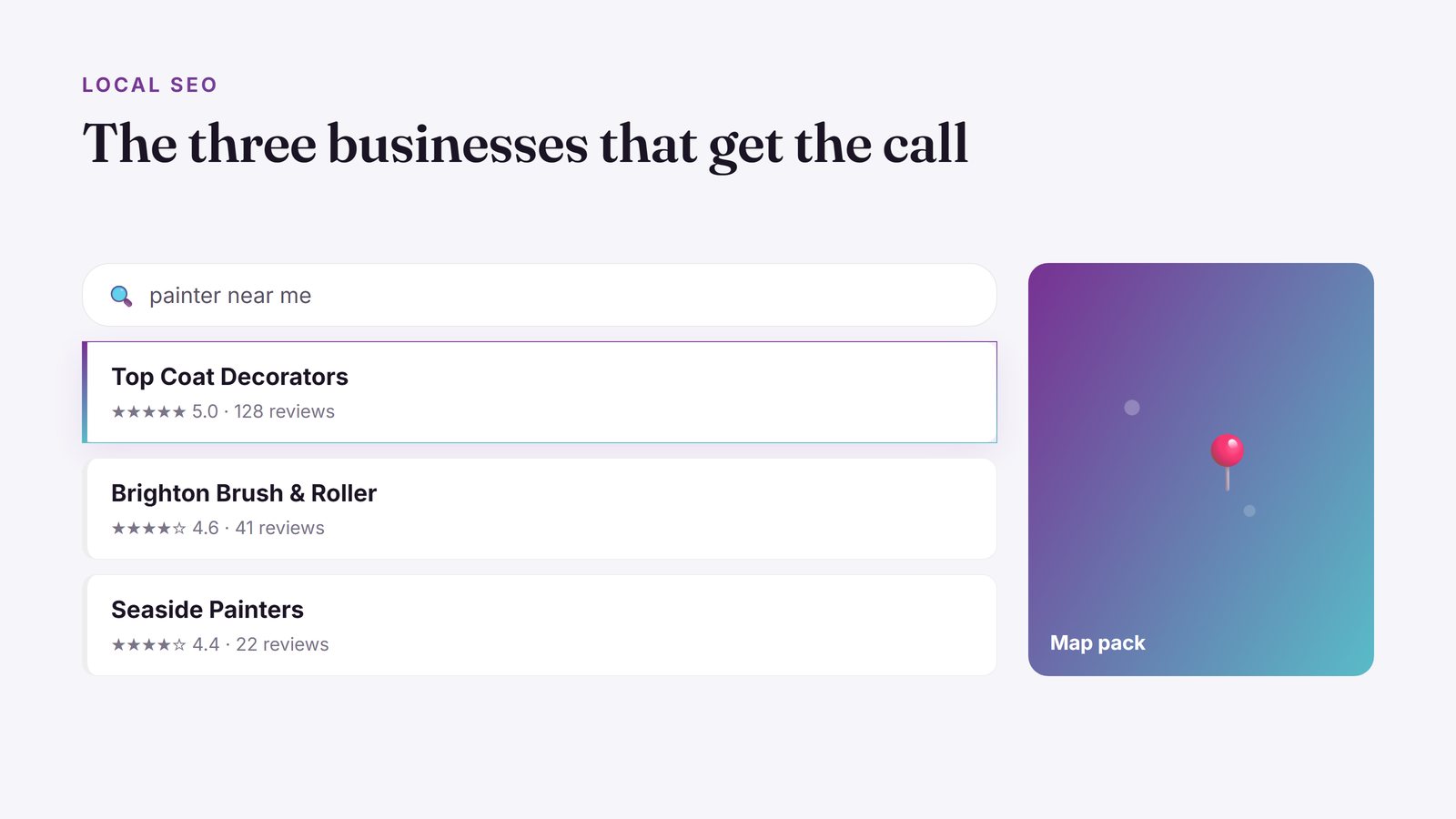
- When someone searches 'painter near me', the three businesses in the map pack get the bulk of the calls.
- The map pack is ranked mostly on relevance, distance, and prominence, not on how nice your website is.
- Reviews are the lever most trades ignore. Steady, recent reviews move the needle more than almost anything else.
- A complete, accurate Google Business Profile with the right primary category is the price of entry.
- Consistency of your name, address and phone across the web quietly builds the trust Google needs to rank you.
When someone in your area pulls out their phone and types "painter near me", Google does not show them ten options. It shows them three, on a map, above everything else. Those three get the calls. Everyone below the map is fighting over the scraps.
That block is the map pack, and getting into it is the single highest-leverage thing a local trade can do online. Not a prettier website. Not more social posts. The map pack.
Here is what actually moves you into it.
How Google decides who gets the three spots
Google ranks the map pack on three things: relevance (do you do what they searched for), distance (how close you are), and prominence (how established and trusted you look). You cannot change distance, so the game is relevance and prominence.
Google is open about this. Its own guidance names relevance, distance, and prominence as the factors behind local ranking.
Distance you cannot do much about. You are where you are. So the work is in the other two: making it crystal clear what you do and where, and looking like an established, trusted business. Most trades lose the map pack not because of distance, but because they look thin to Google.
The Google Business Profile is the price of entry
A complete, accurate Google Business Profile with the correct primary category is non-negotiable. It is the listing the map pack is built from.
Before anything clever, the basics have to be right. Claim the profile. Set the correct primary category (a painter is "Painter", not "Home improvement"). Fill in the service area, the hours, the services, and add real photos of real jobs.
This sounds obvious. It is also where most trades are quietly losing, with a half-filled profile in the wrong category that tells Google very little.
Reviews are the lever nobody pulls
Steady, recent reviews are the biggest thing most trades neglect, and they move ranking more than almost anything else you can control.
If distance is fixed and the profile is table stakes, reviews are where the real movement is. Volume matters, but so does recency and whether you reply. A business getting a couple of genuine reviews a month, every month, looks alive to Google in a way that a business with forty reviews from three years ago does not. Survey after survey, like BrightLocal's annual local consumer review research, shows the same thing: reviews shape both ranking and whether people pick you.
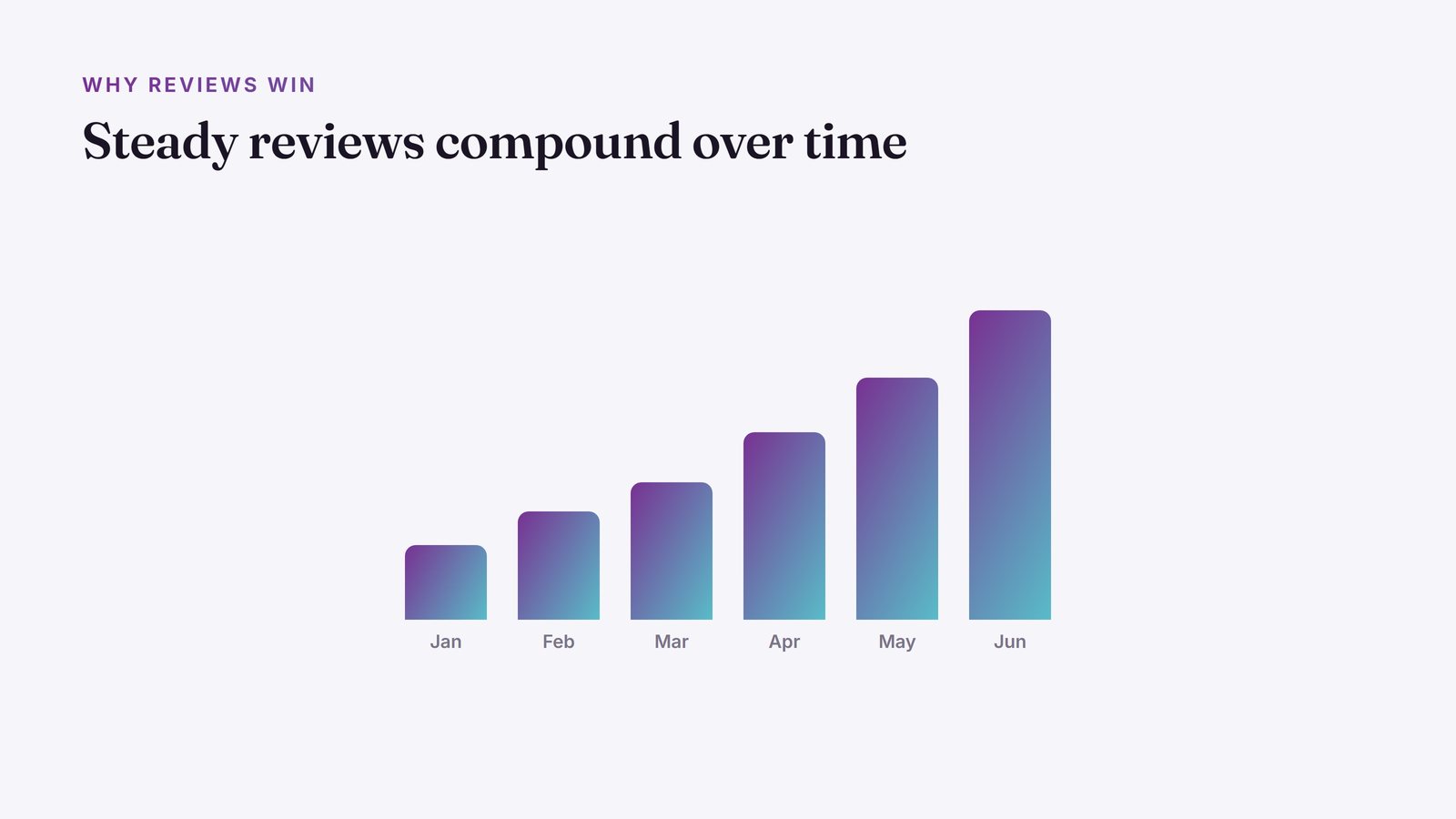
The trades that win here are not the best at the work. They are the best at asking. The simplest system beats the best intentions:
- Ask every happy customer for a review the day the job finishes
- Send a direct link to your Google review page so it takes ten seconds
- Reply to every review, good or bad, in your own voice
- Keep it steady rather than chasing a big one-off batch
Consistency is the quiet one
Your business name, address, and phone number should be identical everywhere they appear online. That consistency builds the prominence Google rewards.
Every place your details appear, a directory, your website, a social profile, is a small signal. When they all match exactly, Google is more confident you are one real, settled business. When the phone number on one directory is three digits different, that confidence erodes.
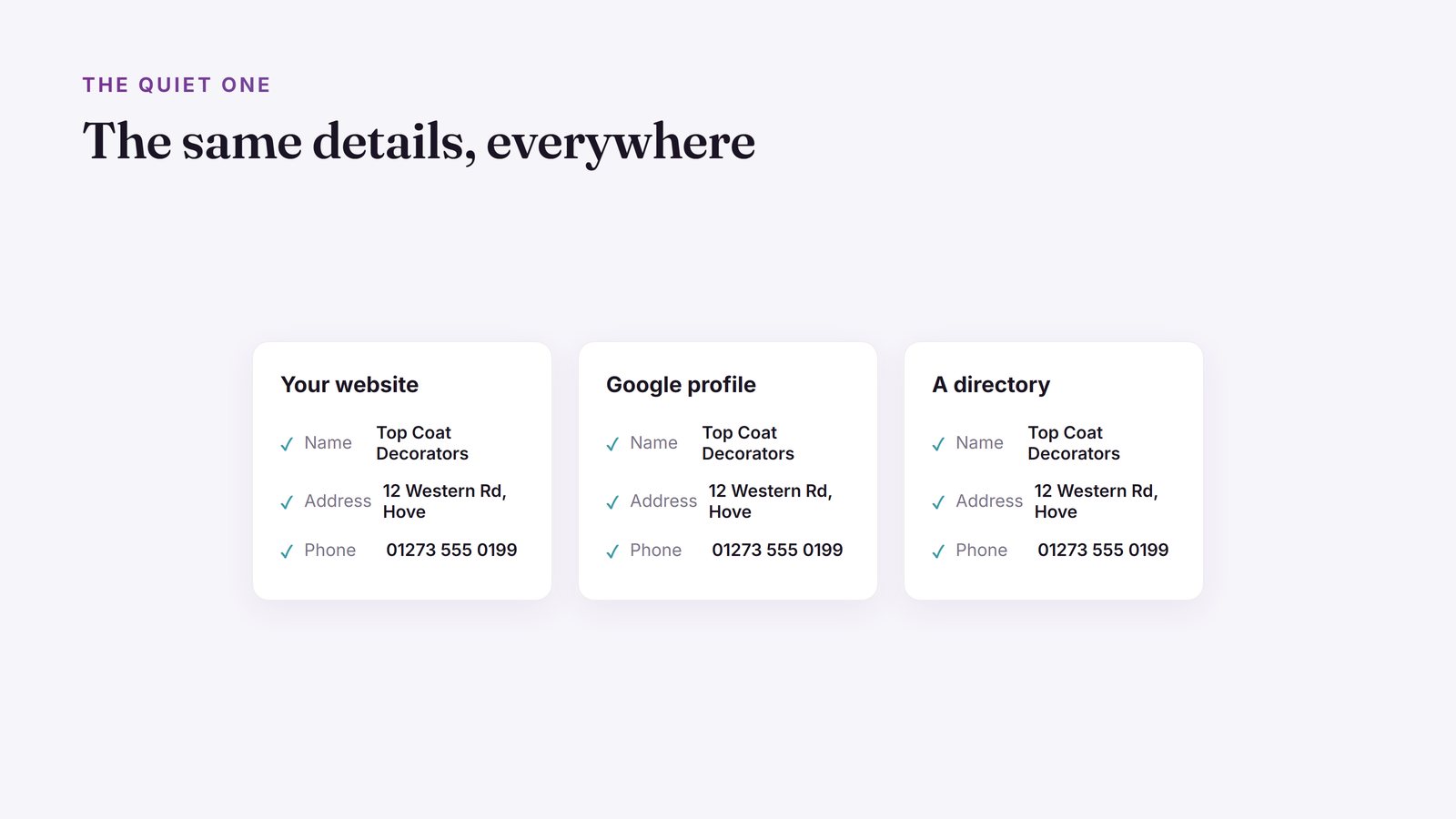
It is unglamorous and it is boring to fix. It is also the kind of quiet groundwork that separates the three businesses in the pack from the ones just below it.
Where to start
If you do one thing this month, build the review habit. It is the highest-leverage move and the one you most control. The profile and the consistency are the foundation; the reviews are what climb you up it.
This is exactly the system I build for the trades I work with, including my own dad's decorating business. The mechanics are simple. Doing them every week is the hard part, which is the whole reason to automate it.
Frequently asked questions
What is the Google map pack?
It is the block of three local businesses Google shows on a map at the top of the results for a local search like 'plumber near me'. Those three spots get most of the clicks and calls, which is why local businesses fight for them.
How long does it take to rank in the map pack?
There is no fixed number, but for most trades it is weeks to a few months of steady work, not days. Reviews and profile completeness move first; broader prominence builds slower. Anyone promising the top spot next week is guessing.
Do I need a website to rank in the map pack?
You can appear without one, but a simple, fast website that matches your Google Business Profile helps Google trust that you are a real, established business. It also gives the people who do click somewhere credible to land.
Are reviews really that important?
Yes. Volume, recency, and your replies all feed prominence, and they are the single biggest thing most trades neglect. A simple system that asks every happy customer for a review will out-rank a competitor who never asks.
What is a citation?
A citation is any mention of your business name, address and phone number on another site, like a directory. When those details are identical everywhere, Google is more confident you are one real business, which supports your ranking.