
n8n explained with dominoes: the mental model that makes it click
Most explanations of n8n start with nodes and webhooks. Here is the simpler way I explain it: stack your tasks like dominoes, knock over the first one, and the rest fall on their own.
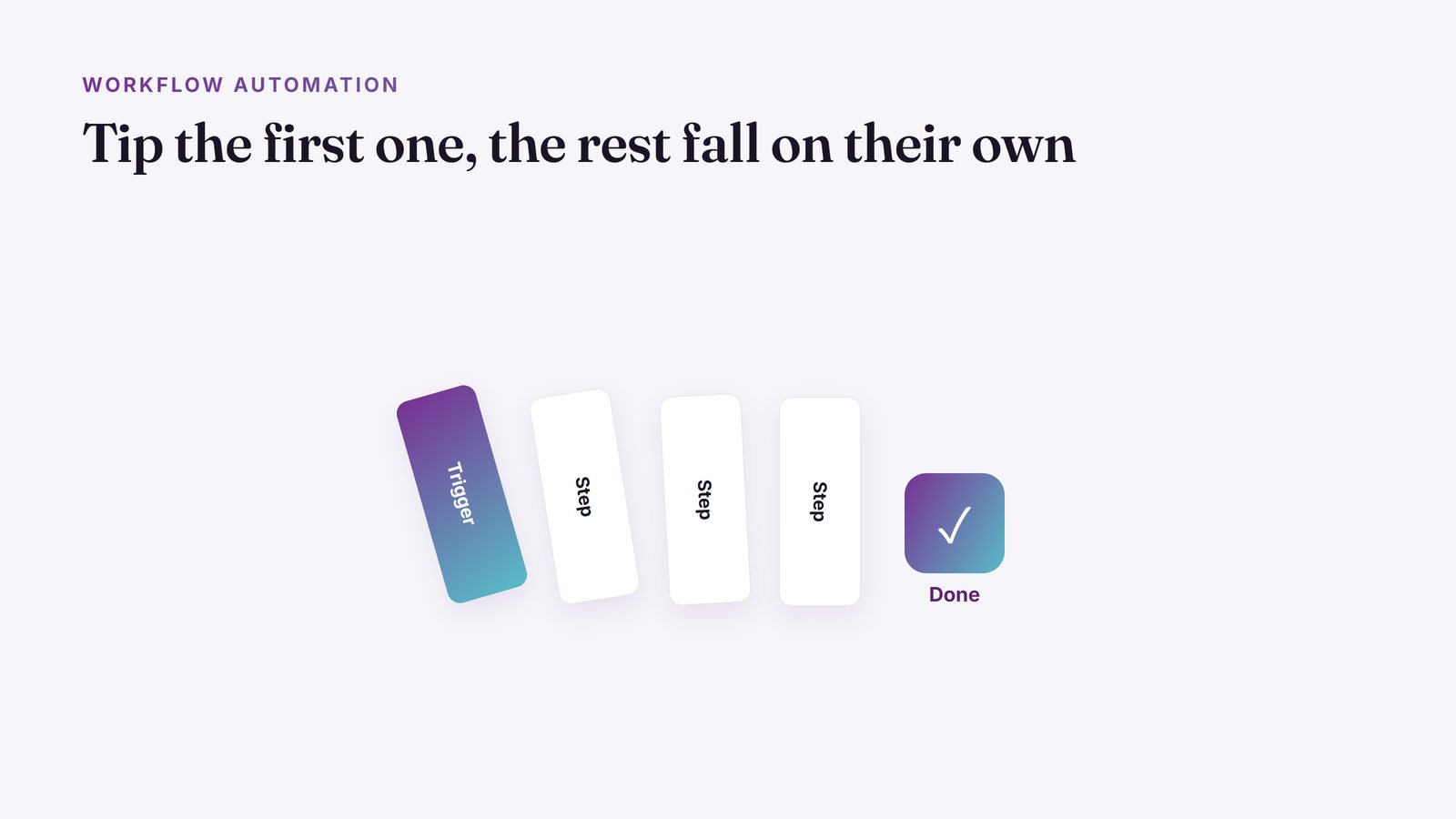
Key takeaways
- n8n is workflow automation: you stack tasks in a sequence and it runs them for you.
- Think of it like dominoes. Set them up once, knock over the first, and the rest fall in order.
- The first domino is the trigger: a form submission, a new email, a file dropped in a folder.
- Each domino after it is a step: send an email, update a sheet, post to a platform, call an API.
- The work is in stacking the dominoes well. Once they are set, the result is the same every time.
Most explanations of n8n lose people in the first minute. Nodes, webhooks, triggers, expressions. All correct, all useless if you do not already get the shape of the thing.
So here is how I explain it instead.
Think of it like dominoes
n8n is dominoes for your tasks. If you can stack your steps in a predictable order, you knock over the first one and n8n knocks over the rest, finishing with the same result every time.
Picture a line of dominoes. Setting them up is the careful part. You place each one so it will knock into the next. But once they are stacked, you only have to do one thing: tip the first one. Everything after that happens on its own, in order, the same way every time.
That is n8n. You stack your tasks in a sequence once. After that, something tips the first task, and the whole chain runs to a finished result without you touching it.
The first domino is the trigger
The trigger is the first domino. It is the event that starts the chain: a form submission, a new email, a scheduled time, or a file dropped into a folder.
Say you have just finished a video. Normally you would upload it, write a description for YouTube, write a different one for LinkedIn, and post it to each by hand. Four jobs, every time.
Now imagine that simply dropping the file into a folder kicked all of that off automatically. The file landing in the folder is the trigger. It is the finger that tips the first domino. n8n calls these trigger nodes, and there is one for almost anything: a new email, a form submission, a schedule, a webhook.
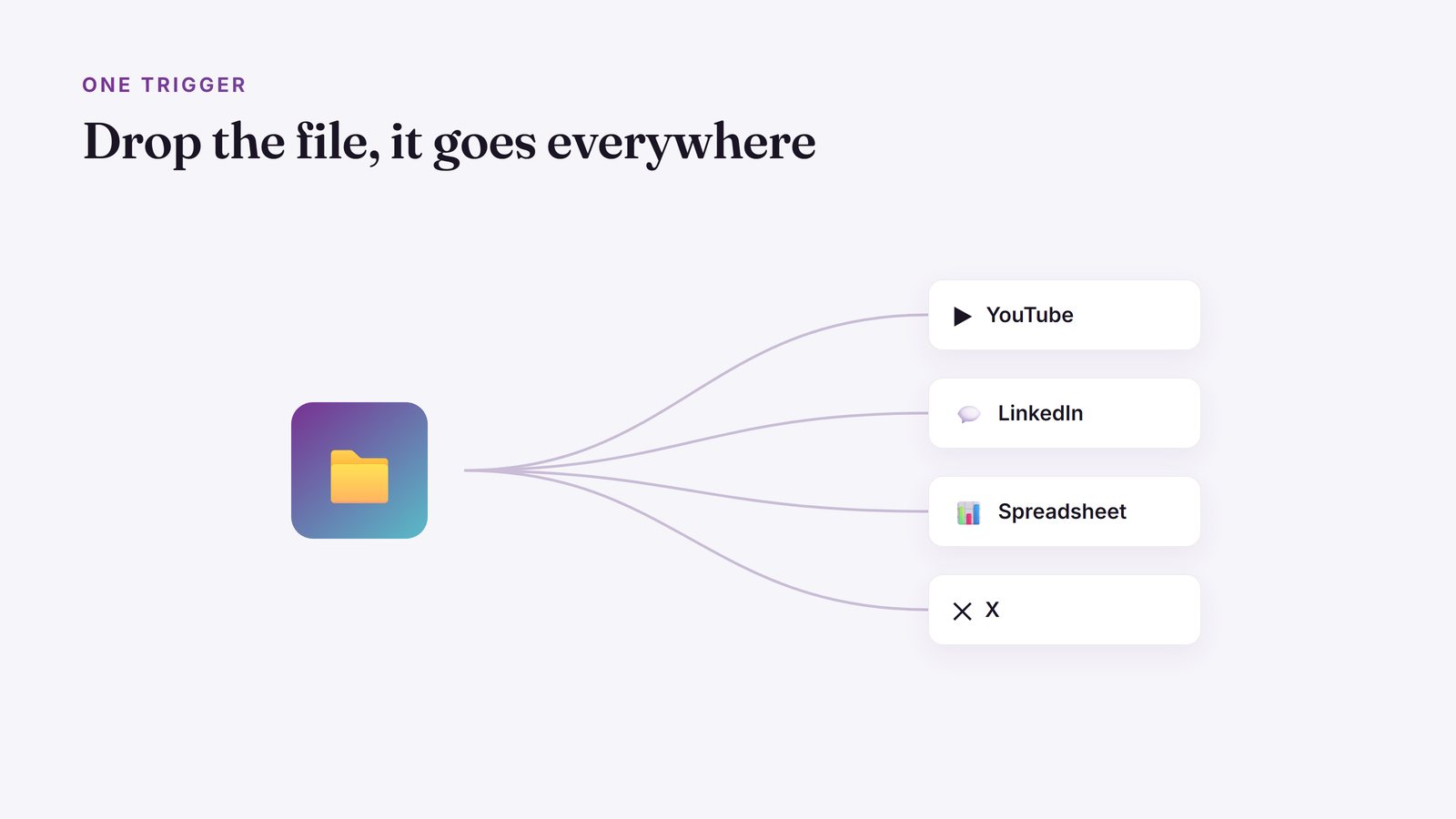
Every domino after it is a step
Each step is one task: send an email, update a spreadsheet, call an API, post to a platform. They fall in the order you stacked them.
After the trigger, each domino is a single task n8n does for you, in sequence:
- Read the file that just landed
- Generate a title and description for each platform
- Upload it to YouTube with its description
- Post it to LinkedIn with a different one
- Log it in a spreadsheet so you have a record
You stacked those dominoes once. From then on, every video that lands in the folder runs the exact same chain. The result is the same every time, which is the whole point.
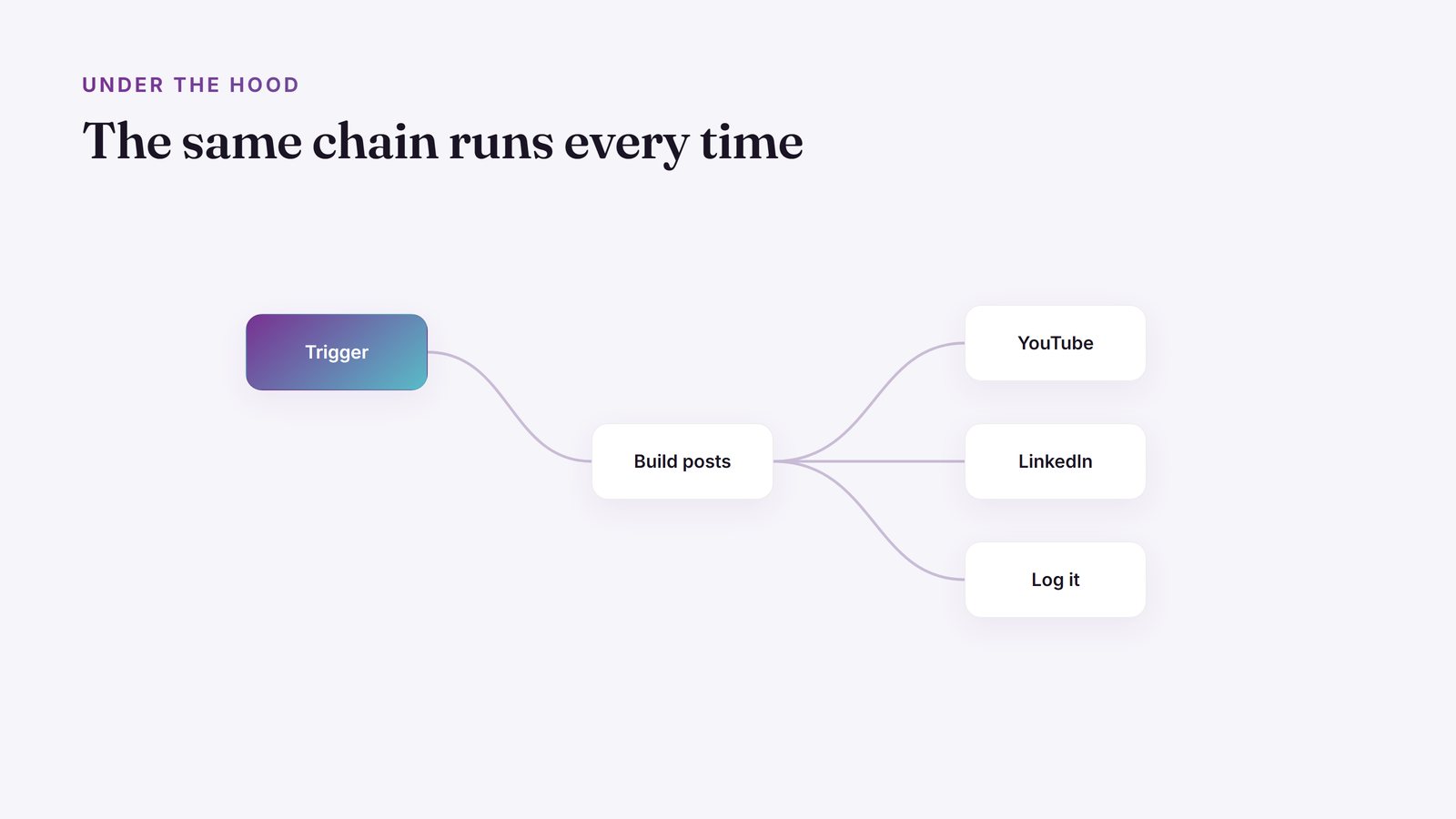
The work is in stacking the dominoes well. Once they are set, you only ever tip the first one.
Where the value really is
The magic is not any single step. You could do all of them by hand. The value is that you do the thinking once, stack the sequence, and then never spend that attention again. The fortieth run costs you nothing.
That is why the businesses that lean into this pull ahead. They are not working harder on the repetitive stuff. They stacked the dominoes, and now they just tip them.
This is the engine under most of what I build. The AI assistant I gave my dad's painting business runs on a chain like this, and so does the loop that reviews my own work every morning. Same idea every time: find the predictable sequence, stack it once, stop doing it by hand. If you want to go deeper, the n8n docs are genuinely good. Find your first set of dominoes and tip them.
Frequently asked questions
What is n8n in plain English?
It is a tool that lets you connect your apps and run a sequence of tasks automatically. You define the steps once, and from then on it does them for you whenever something kicks the sequence off.
What is a trigger?
The trigger is the first domino, the thing that starts the sequence. It might be a new form submission, an incoming email, a scheduled time, or a file landing in a folder. Everything else falls after it.
Do I need to be a developer to use n8n?
No. You build workflows visually by connecting blocks, so you can get a long way without writing code. It helps to think logically about the order of your steps, but that is a different skill from programming.
What kinds of things can it automate?
Anything that is a predictable sequence of steps across your tools. Lead capture, follow-up emails, updating a CRM, posting content to several platforms, syncing data between apps. If you can describe it as 'when X happens, do Y then Z', it is a candidate.
When is n8n not the right tool?
When the task needs real-time judgement on every run, or the steps change every time. n8n shines on predictable, repeatable sequences. If there is no predictable order to stack, there are no dominoes to knock over.