
What an AI agent actually is: tools, memory, and a brain
Most people picture a chatbot. An AI agent is a different thing entirely. Here is the plain-English version: a brain that reasons, memory, and tools it can use to act on your behalf.
Key takeaways
- An AI agent is a model with three things added: memory, and tools it can actually use, plus a goal to work toward.
- A chatbot answers the question in front of it. An agent takes action to get something done.
- It works in a loop: think, use a tool, check the result, repeat until the goal is met.
- Good uses are real tasks with predictable shape: booking, follow-ups, research, updating systems.
- Agents are not magic. They need clear goals, the right tools, and a human checking the important calls.
Most people picture a chatbot when they hear "AI agent". Something you type a question into and it types an answer back. That is not what an agent is, and the gap between the two is the whole point.
A chatbot talks. An agent does things.
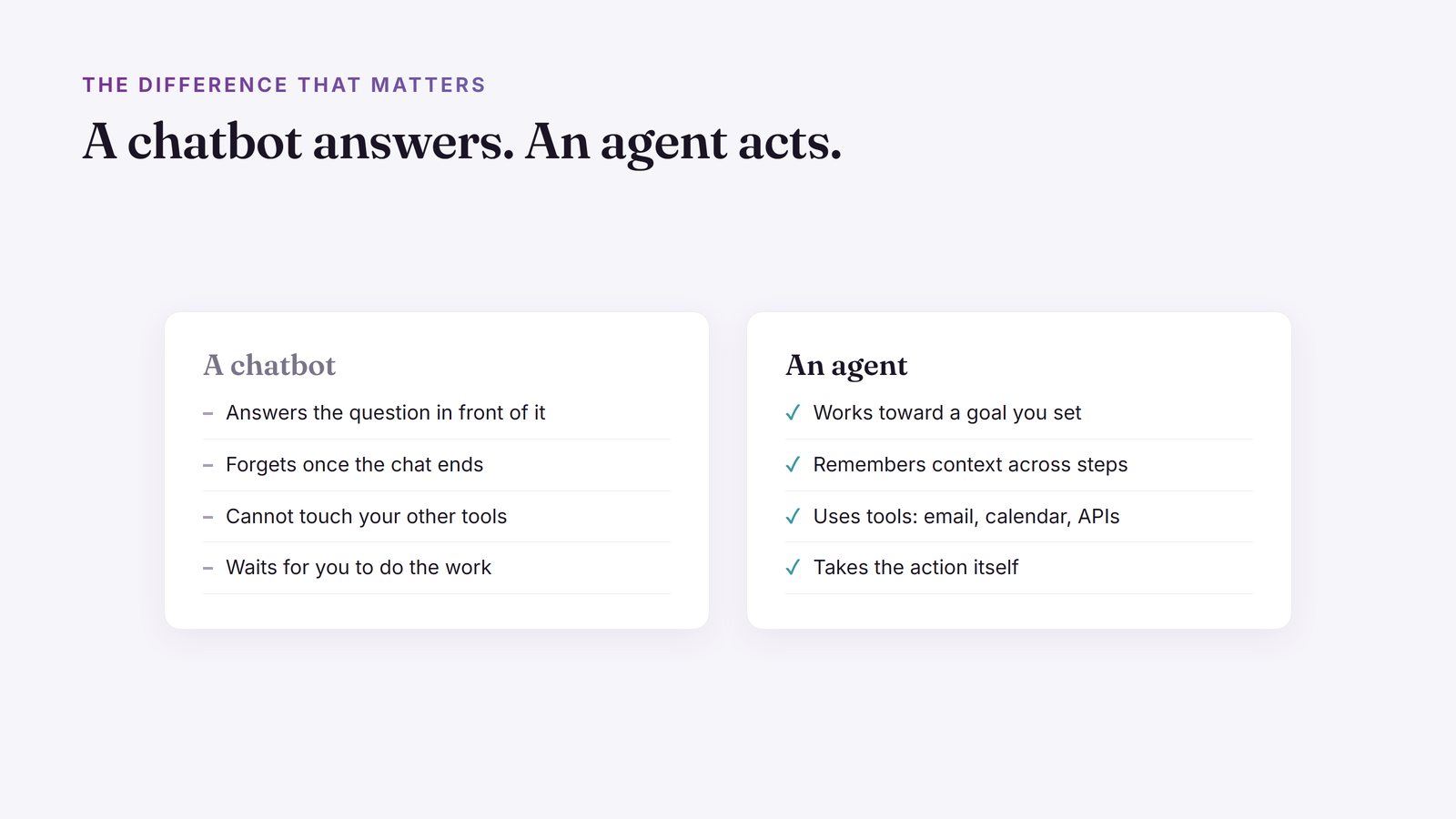
A chatbot answers. An agent acts.
A chatbot responds to the message in front of it and forgets. An AI agent works toward a goal you set, remembers what has happened, and uses tools to take action on your behalf.
Think about asking a normal chatbot to book a meeting. It will tell you how to book a meeting. It might even draft the email. But you still have to send it, check the calendar, and follow up. The chatbot hands the work back to you.
An agent does the booking. It checks your calendar, drafts the reply, sends it, and logs the result. Same starting request, completely different ending.
So what is an AI agent?
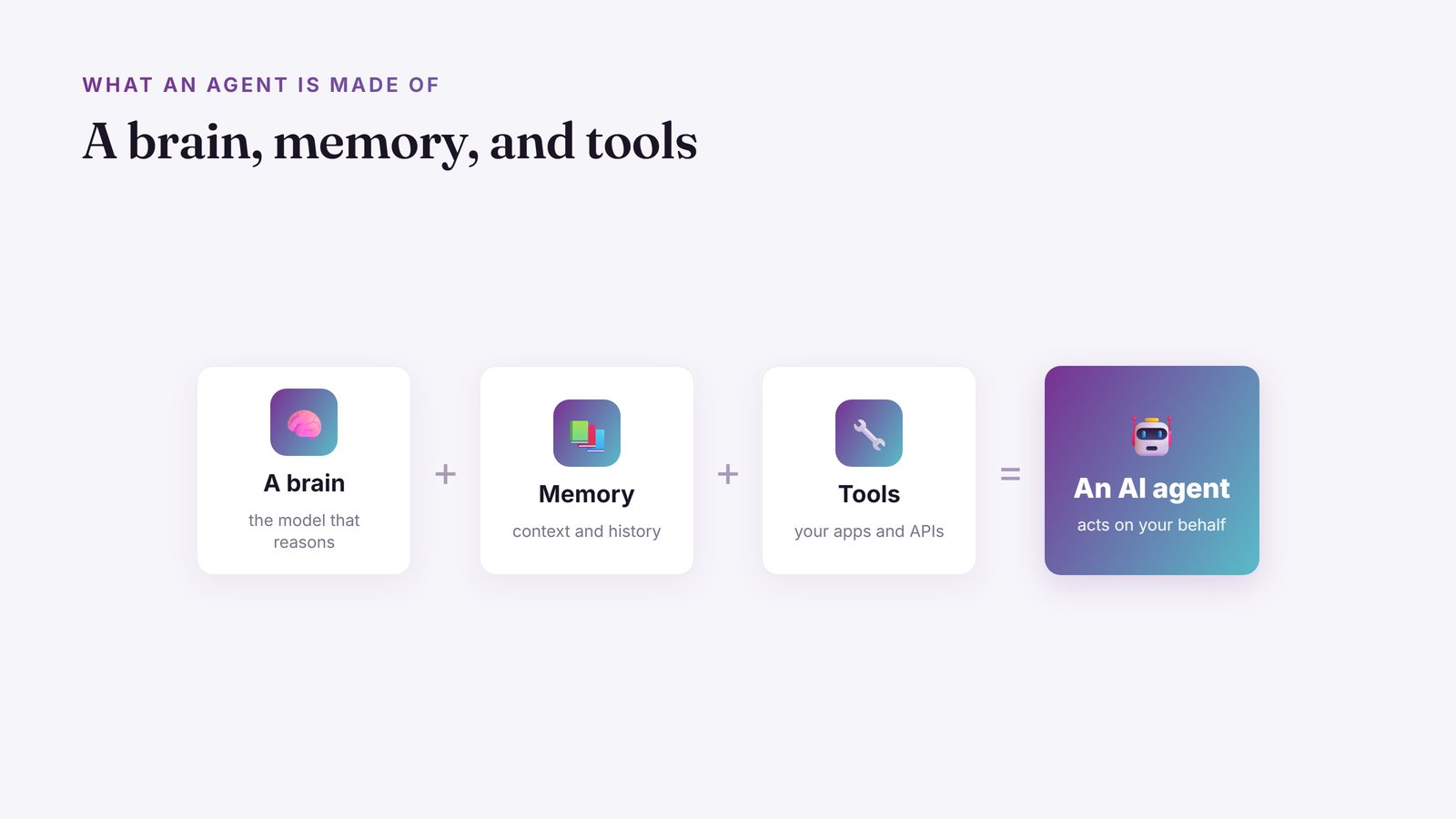
An AI agent is a model with three things added: memory so it can hold context, tools it can actually use, and a goal to work toward. Give it those, and it can do real work instead of just talking about it.
The model on its own is the brain. It can reason, but it is sealed in a box. It cannot see your calendar, send an email, or remember what you told it yesterday.
You turn it into an agent by giving it three things:
- Memory. Context it can carry across steps: what the goal is, what it has already tried, what you told it last week.
- Tools. The hands. Access to your email, your calendar, a database, or any API. This is what lets it act in the real world rather than just describe it. Anthropic's Model Context Protocol is one common way to plug these tools in.
- A goal. Something to work toward, not just a question to answer.
A brain, plus memory, plus tools, working toward a goal. That is the whole recipe. Everything else is detail.
How do AI agents actually work?
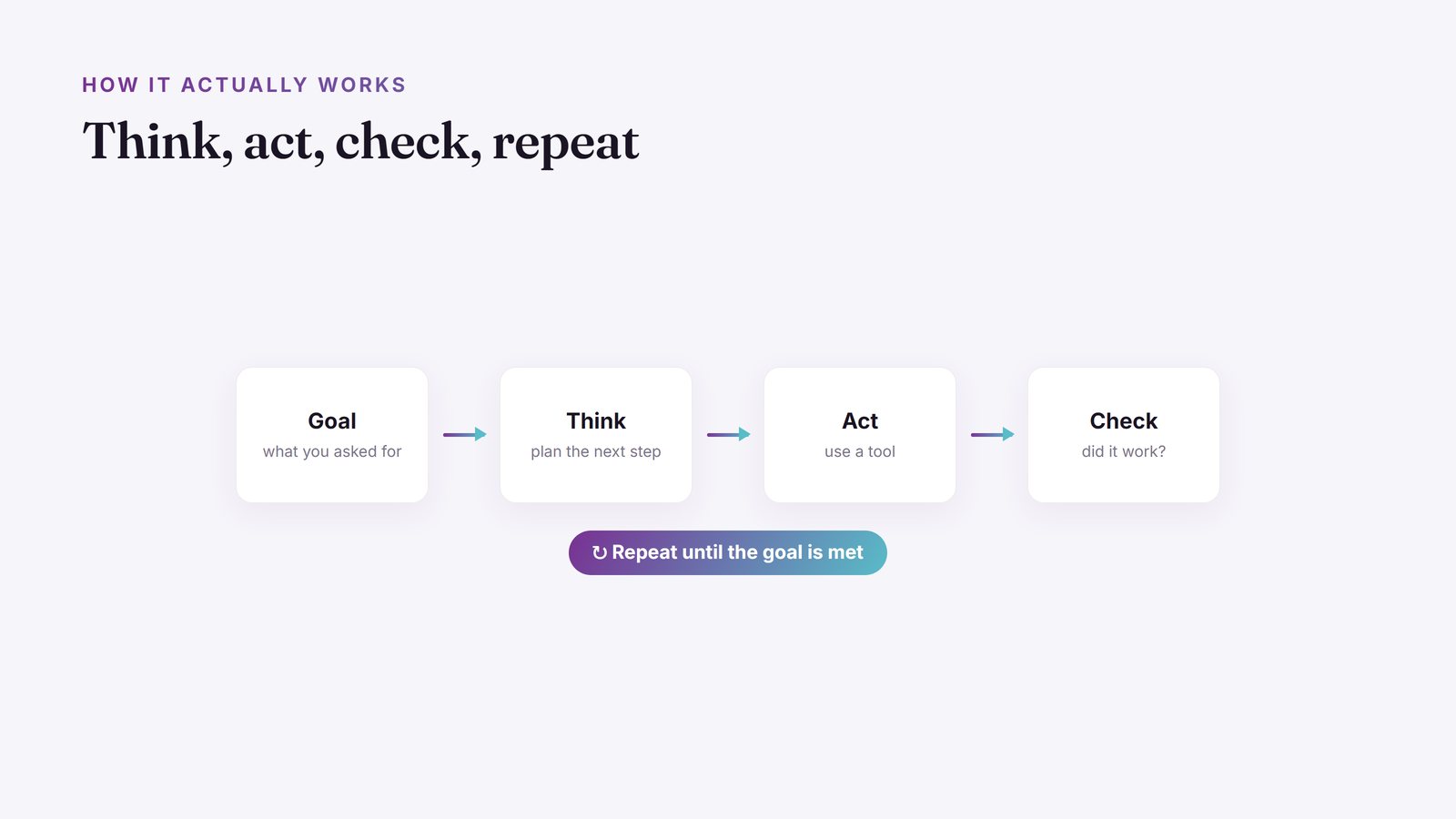
An agent runs in a loop: it looks at the goal, decides the next step, uses a tool to do it, checks the result, and repeats until the goal is met.
This is the part that makes it feel different from a chatbot. A chatbot does one round trip: you ask, it answers, done. An agent keeps going.
It looks at the goal, picks the next sensible step, uses a tool to do it, then checks whether that worked. If it did not, it tries something else. It loops like that until the job is finished or it hits a point where it genuinely needs you.
The model is the brain. Memory and tools are what let it stop talking and start working.
This is also why agents and fixed automations are not the same thing. A workflow tool like n8n runs a set sequence every time, the same steps in the same order. An agent decides its own next step based on what it finds. Workflows are predictable and cheap; agents are flexible and handle the messy cases. Most useful systems end up using both.
What people actually use AI agents for
The good uses all share a shape: a real task, predictable enough to describe, with a clear finish line. A few that are working in the wild right now:
- Turning an enquiry into a booked job, calendar and confirmation included
- Chasing leads that went quiet and replying when they come back
- Pulling scattered research into a single brief before a meeting
- Reconciling invoices against payments and flagging what does not match
- Reviewing work and proposing fixes, which is exactly what I have one of mine doing to my own tooling every morning
None of these are flashy. That is the point. The valuable agents are the ones quietly removing a repetitive job nobody wanted to do.
Where agents fall down
Agents are not magic, and pretending otherwise is how people get burned. They go wrong in predictable ways: a vague goal sends them down a rabbit hole, a missing tool leaves them stuck, and too much freedom lets them take an action you did not want.
The fix is not to avoid them. It is to keep a human on the decisions that matter. Let the agent do the work, but make it check in before anything that spends money or reaches a customer. Give it narrow tools and clear limits first, then widen them as it earns trust. For a deeper take on building these well, Anthropic's guide to building effective agents is the clearest thing I have read.
I genuinely think the businesses that get comfortable with this early will pull ahead, not because agents are clever, but because they quietly do the repetitive work that used to eat people's days. The ones who wait will be competing against teams that stopped doing that work by hand.
If you want an agent like this built for your business, that is what I do at RomanLogic. Start with one repetitive task you would happily never do again. That is almost always the right first agent.
Frequently asked questions
What is an AI agent in plain English?
It is an AI model given a goal, some memory, and a set of tools it can use, like your email, calendar, or an API. Instead of just answering you, it works through the steps to actually get the task done and reports back.
What is the difference between an AI agent and a chatbot?
A chatbot answers the question in front of it and then forgets. An agent works toward a goal you set, remembers context across steps, and can use tools to take action. The chatbot tells you what to do; the agent does it.
How do AI agents work?
They run in a loop. The agent looks at the goal, decides the next step, uses a tool to do it, checks whether it worked, and repeats. It keeps going until the goal is met or it hits a point where it needs a human.
What are some examples of AI agents?
Booking a job from an enquiry, chasing unanswered leads, pulling research into a brief, reconciling invoices, or posting content across platforms. Anything that is a real task with a predictable shape and a clear finish line.
Are AI agents safe to let loose on my business?
Not blindly. The sensible pattern is to let the agent do the work but keep a human approving the decisions that matter, like anything that spends money or goes to a customer. Give it narrow tools and clear limits, then widen them as you trust it.